Scar Revision & Keloid Treatment✦ in Pune
(Geometric Z-Plasty, Contracture Release & Multimodal Keloid Care)
Advanced Surgical Scar Revision, Geometric Broken-Line Z-Plasty & Multimodal Keloid Protocol
Visible scars from prior accidents, emergency surgeries, burns, or severe acne can serve as a constant, unwanted reminder of past trauma. While no surgeon can make a scar vanish entirely, plastic surgery possesses extraordinary techniques to transform wide, thickened, or depressed scars into soft, hairline marks that blend imperceptibly into natural skin folds. Dr. Chintan Gujarathi combines micro-surgical excision, geometrical realignment, and multimodal keloid therapies to restore skin confidence.
Operated by Dr. Chintan Gujarathi (MCh Plastic Surgery, Tata Memorial Hospital Fellow) at accredited tertiary centers (Ruby Hall Clinic, Sassoon Rd & Manipal Hospital Kharadi), utilizing sub-millimeter precision, concealed micro-incisions, and advanced tissue-handling for natural, permanent outcomes.
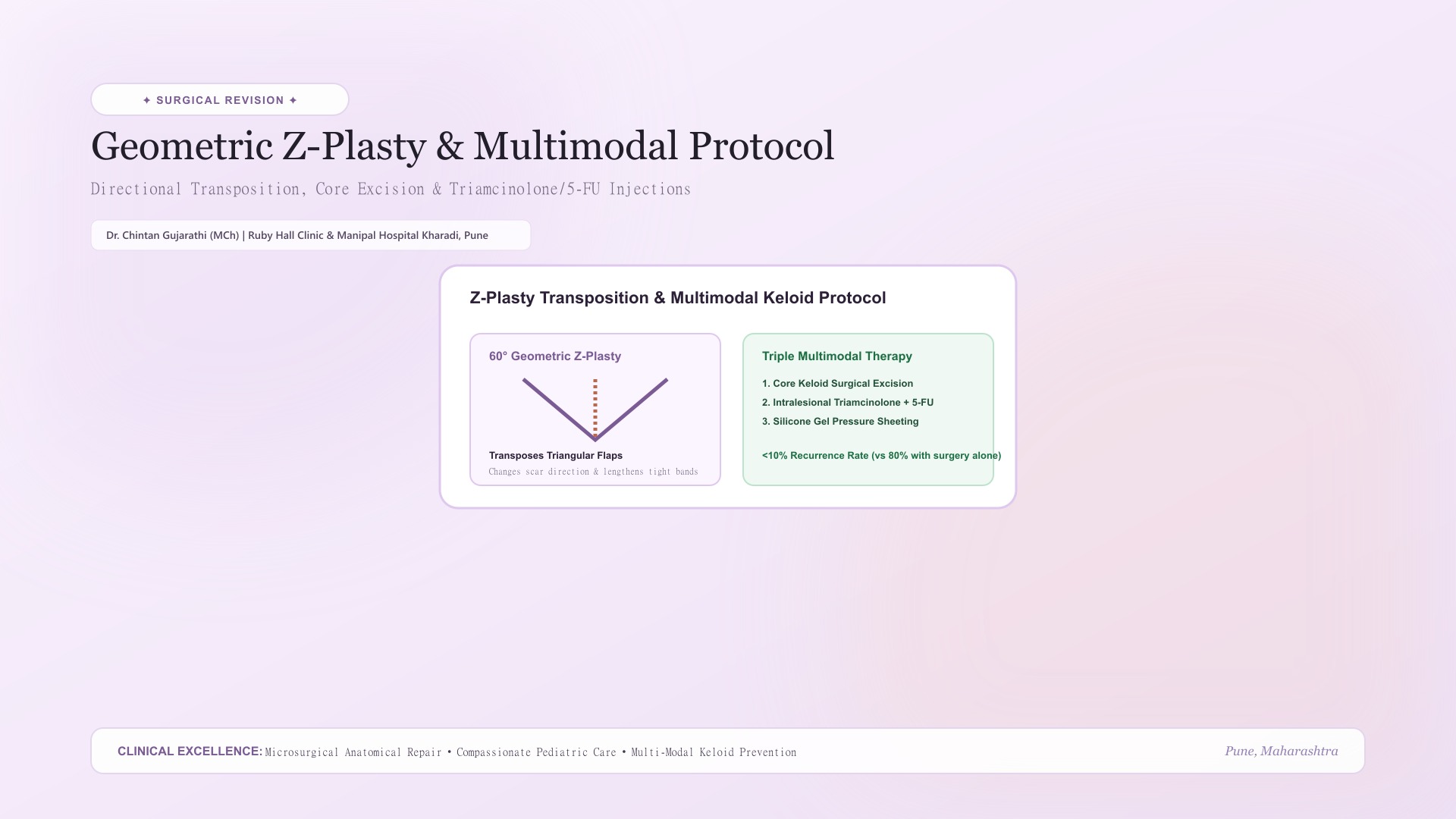
<10% — Keloid Recurrence
Triple multimodal therapy
60° — Z-Plasty Angles
Tension reorientation
100% — Subdermal Absorption
Zero surface tension
12 Months — Collagen Maturation
Invisible hairline scar
Surgical Approaches & Precision Techniques✦
Geometric Broken-Line & Z-Plasty Scar Realignment
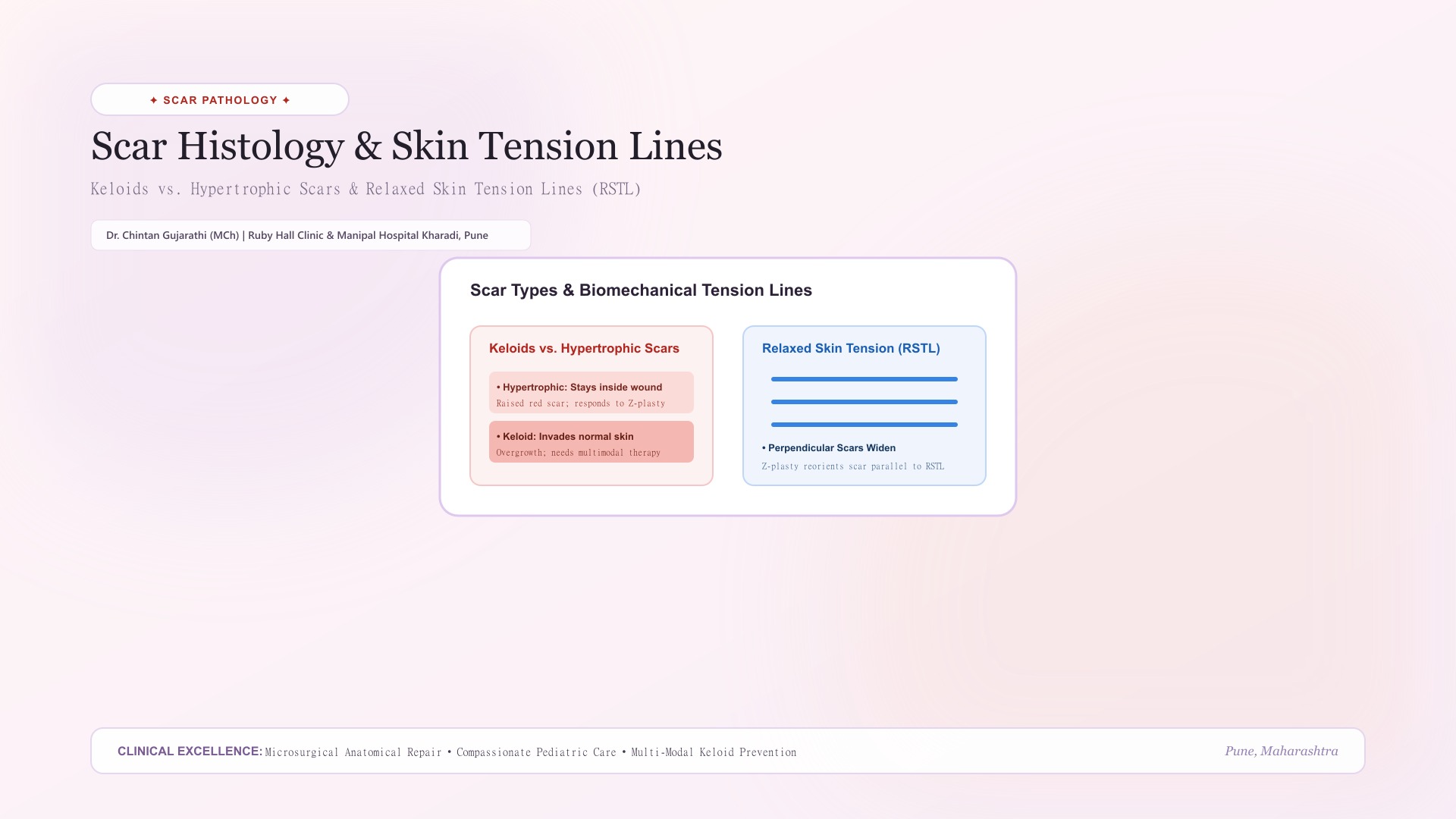
Excision of thick, widened, or depressed scars and reorientation of tension vectors parallel to natural relaxed skin tension lines (RSTL).
Your Healing Journey & Care Guide✦
A straightforward clinical guide to what to expect and how to care for your results.
Painless In-Home Healing
Minimal pain, easily managed with mild oral analgesics. A light waterproof dressing protects the revised site.
Keeping pressure on the scar area with prescribed tapes reduces local capillary blood flow, preventing thick scar formation.
Early Fine Suture Removal
Hairline stitches are painlessly removed at the clinic. The new incision line appears as a clean, thin reddish-pink mark.
Early suture removal prevents any cross-hatch railroad marks, keeping the new scar line completely smooth.
Active Silicone Therapy & Massage
The scar is actively remodeling. Medical-grade silicone gel or sheets are worn daily to flatten collagen fibers.
Consistent silicone gel application for 3 months is scientifically proven to reduce scar thickness by up to 80%.
Complete Maturation & Invisibility
The pink color fades to match surrounding skin tone. The scar softens, flattens completely, and becomes barely noticeable.
Scars continue to mature for up to a full year, becoming progressively softer, flatter, and even less visible over time.
Recommended Best Practices (Do's)
- Apply medical silicone gel or silicone sheeting over the revised scar daily for at least 3 to 6 months.
- Perform gentle, firm circular massage over the scar line for 2 minutes twice a day once stitches are removed.
- Protect the healing scar from direct sunlight with broad-spectrum SPF 50+ sunscreen for at least 12 months.
- For keloid patients, attend scheduled monthly follow-up appointments for maintenance micro-injections if advised.
- Keep supportive tape (Steri-Strips) over the scar for the first 2 to 3 weeks to prevent widening.
Precautions & Safeguards (Don'ts)
- Do not expose fresh scars to direct tanning or harsh sunlight, as ultraviolet rays cause permanent hyperpigmentation (darkening).
- Do not scratch, rub, or peel scabs along the healing incision line.
- Do not perform heavy weightlifting or aggressive stretching across the scar area for the first 4 weeks.
- Do not skip prescribed silicone sheeting or pressure garment wear if you have a history of keloid formation.
- Do not smoke or use nicotine, as poor microvascular circulation leads to thicker, delayed scars.
Frequently Asked Questions✦
Essential clinical answers on surgical safety, scars, and recovery in Pune.
Schedule Your Consultation with Dr. Chintan Gujarathi
Available for personal clinical consultations and surgical assessment at premier accredited tertiary hospitals in Pune: