Nail Bed Injury & Fingertip Repair✦ in Pune
(Micro-Matrix Repair, Subungual Hematoma Drainage & Atasoy V-Y Flap Coverage)
Perionychial Microsurgical Reconstruction, Matrix Repair & Local Flap Phalanx Coverage
Fingertips and nail beds are delicate, highly innervated sensory organs essential for fine pinch, object manipulation, and digit protection. Crush injuries from car doors, heavy machinery, or sports frequently cause severe subungual hematomas, complex nail bed lacerations, or fingertip pulp amputations. Improper initial treatment leads to chronic nail deformities like split nails, pterygium, hooked nails, or painful hypersensitive fingertips. Dr. Chintan Gujarathi utilizes operating loupe magnification and 7-0 micro-sutures to meticulously realign the germinal and sterile matrices, anatomical nail splints to maintain the eponychial fold, and local neurovascular advancement flaps (Atasoy / Kutler) to preserve finger length, natural contour, and discriminative sensation.
Operated by Dr. Chintan Gujarathi (MCh Plastic Surgery, Tata Memorial Hospital Fellow) at accredited tertiary centers (Ruby Hall Clinic, Sassoon Rd & Manipal Hospital Kharadi), utilizing sub-millimeter precision, concealed micro-incisions, and advanced tissue-handling for natural, permanent outcomes.
7-0 Micro — Matrix Sutures
Dissolvable micro-stitching
30-45 Min — Day-Care Procedure
Painless digital block
100% — Pulp Sensation
Neurovascular preservation
0.1 mm/day — Plate Regrowth
Smooth anatomical nail bed
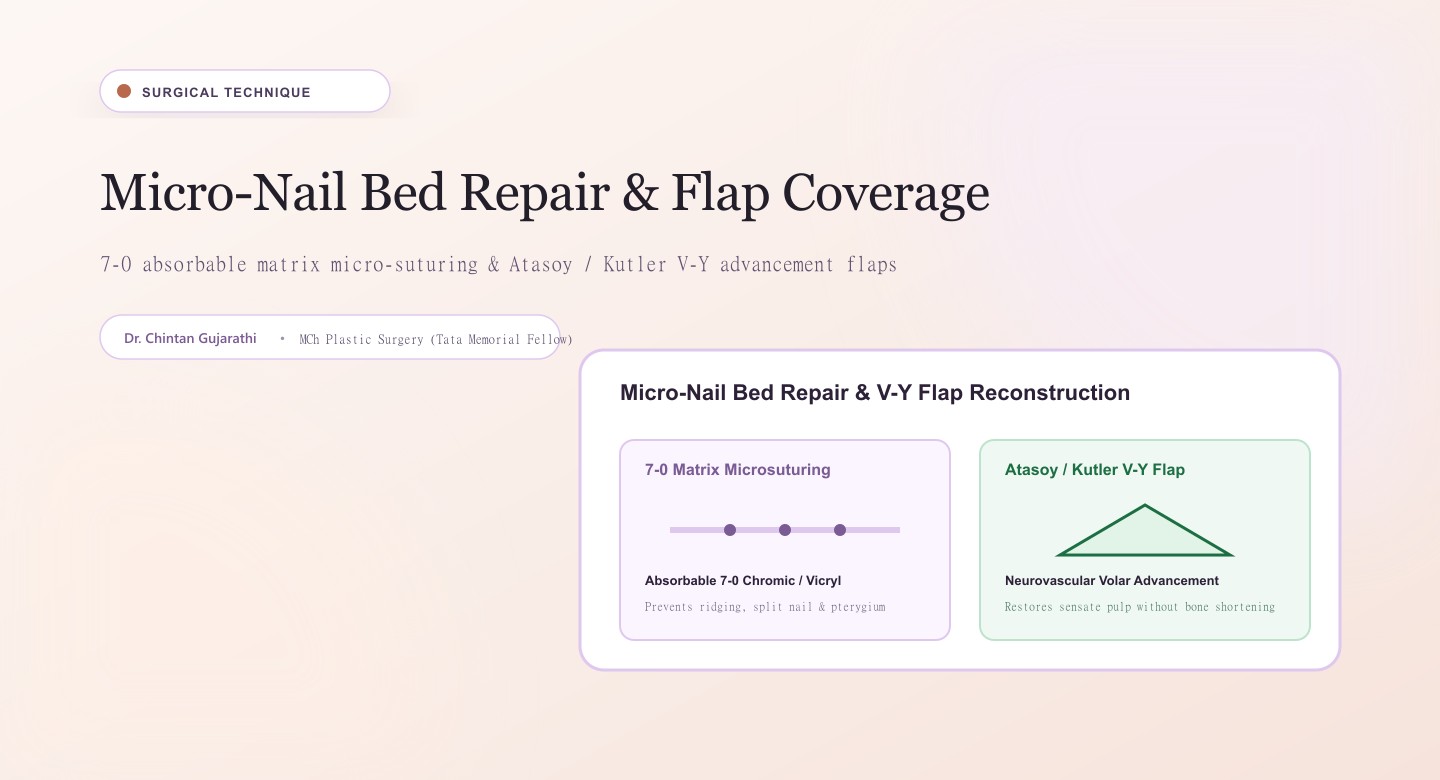
Surgical Approaches & Precision Techniques✦
Micro-Nail Bed Repair & Plate Splinting
Painless extraction of avulsed nail, 7-0 chromic/Vicryl micro-suturing of germinal and sterile matrix, and anatomical splinting.
Your Healing Journey & Care Guide✦
A straightforward clinical guide to what to expect and how to care for your results.
Immediate Decompression & Elevation
Significant relief of throbbing pain. Mild fingertip tenderness well managed with oral analgesics.
Do not let the hand hang downward while walking; use an arm sling or rest hand on chest.
First Dressing Change & Splint Inspection
Wound review at Ruby Hall Clinic or Manipal Hospital Kharadi. The protective nail splint remains securely in place.
The temporary nail stent will naturally detach after 2 to 3 weeks as the new nail starts growing from the germinal root.
Pulp Desensitization & Early Motion
Active functional use of the hand for light tasks. Fingertip skin is healed and re-epithelialized.
Gentle tapping and texture exposure prevents long-term fingertip hypersensitivity after crush injuries.
Complete Nail Plate Regrowth
The new nail plate has grown fully from base to tip at ~0.1 mm/day, adhering smoothly to the repaired sterile bed.
A minor transverse ridge may mark the initial trauma level, which will gradually grow out completely over 4 to 6 months.
Recommended Best Practices (Do's)
- Keep your hand elevated on pillows while resting to minimize throbbing and swelling.
- Keep the protective finger dressing strictly clean, dry, and waterproofed during bathing.
- Move your uninjured fingers and wrist actively through full range of motion every few hours.
- Follow up on Day 7 to 10 for scheduled sterile wound evaluation and splint dressing change.
Precautions & Safeguards (Don'ts)
- Do not pull, trim, or pry off the protective nail splint, even if it feels slightly loose.
- Do not submerge the injured finger in water, swimming pools, or dishwater until cleared.
- Do not engage in heavy weight lifting, manual gripping, or sports for the first 3 weeks.
- Do not peel peeling crusts or apply unprescribed homemade herbal remedies to the wound.
Frequently Asked Questions✦
Essential clinical answers on surgical safety, scars, and recovery in Pune.
Schedule Your Consultation with Dr. Chintan Gujarathi
Available for personal clinical consultations and surgical assessment at premier accredited tertiary hospitals in Pune: