AV Fistula Creation✦ in Pune
(Radiocephalic & Brachiocephalic Dialysis Vascular Access)
Microsurgical Arteriovenous Fistula Creation (Radiocephalic, Brachiocephalic & Basilic Transposition)
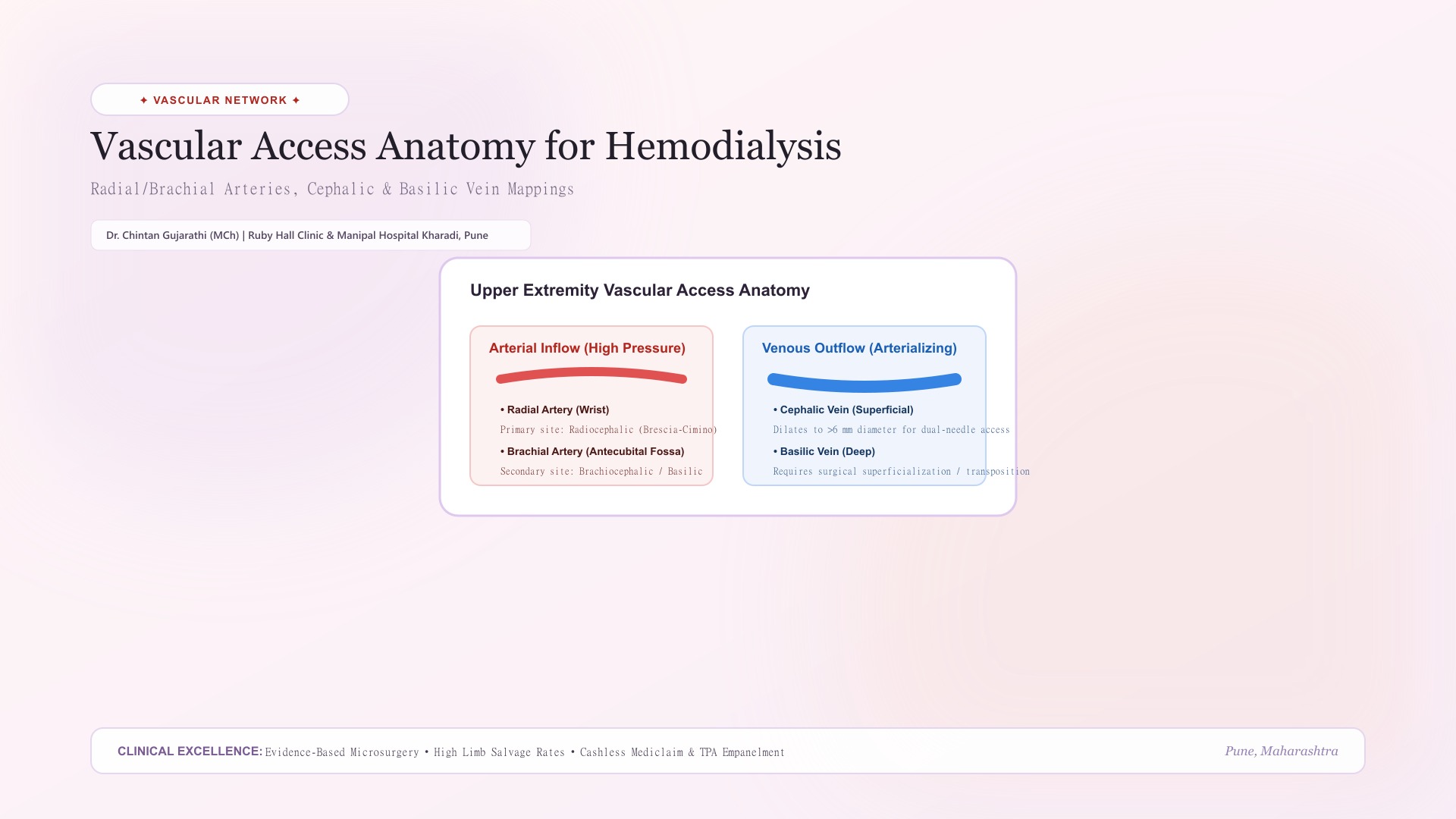
For patients diagnosed with chronic kidney disease (CKD) or end-stage renal disease (ESRD), creating a secure, reliable vascular access is literally establishing a lifeline for life-sustaining hemodialysis. A native arteriovenous (AV) fistula—created by surgically joining a high-pressure artery to an adjacent superficial vein—is universally acknowledged by nephrologists as the safest, longest-lasting form of vascular access. Dr. Chintan Gujarathi utilizes super-specialized microsurgical techniques to fashion resilient AV fistulas with exceptionally high primary patency rates.
Operated by Dr. Chintan Gujarathi (MCh Plastic Surgery, Tata Memorial Hospital Fellow) at accredited tertiary centers (Ruby Hall Clinic, Sassoon Rd & Manipal Hospital Kharadi), utilizing sub-millimeter precision, concealed micro-incisions, and advanced tissue-handling for natural, permanent outcomes.
>600 mL — Target Flow Rate
Maturation flow / min
>6 mm — Arterialized Vein
Dual needle diameter
7-0 / 8-0 — Micro-Sutures
Vascular anastomosis
6 Weeks — Maturation Time
Rule of 6s protocol
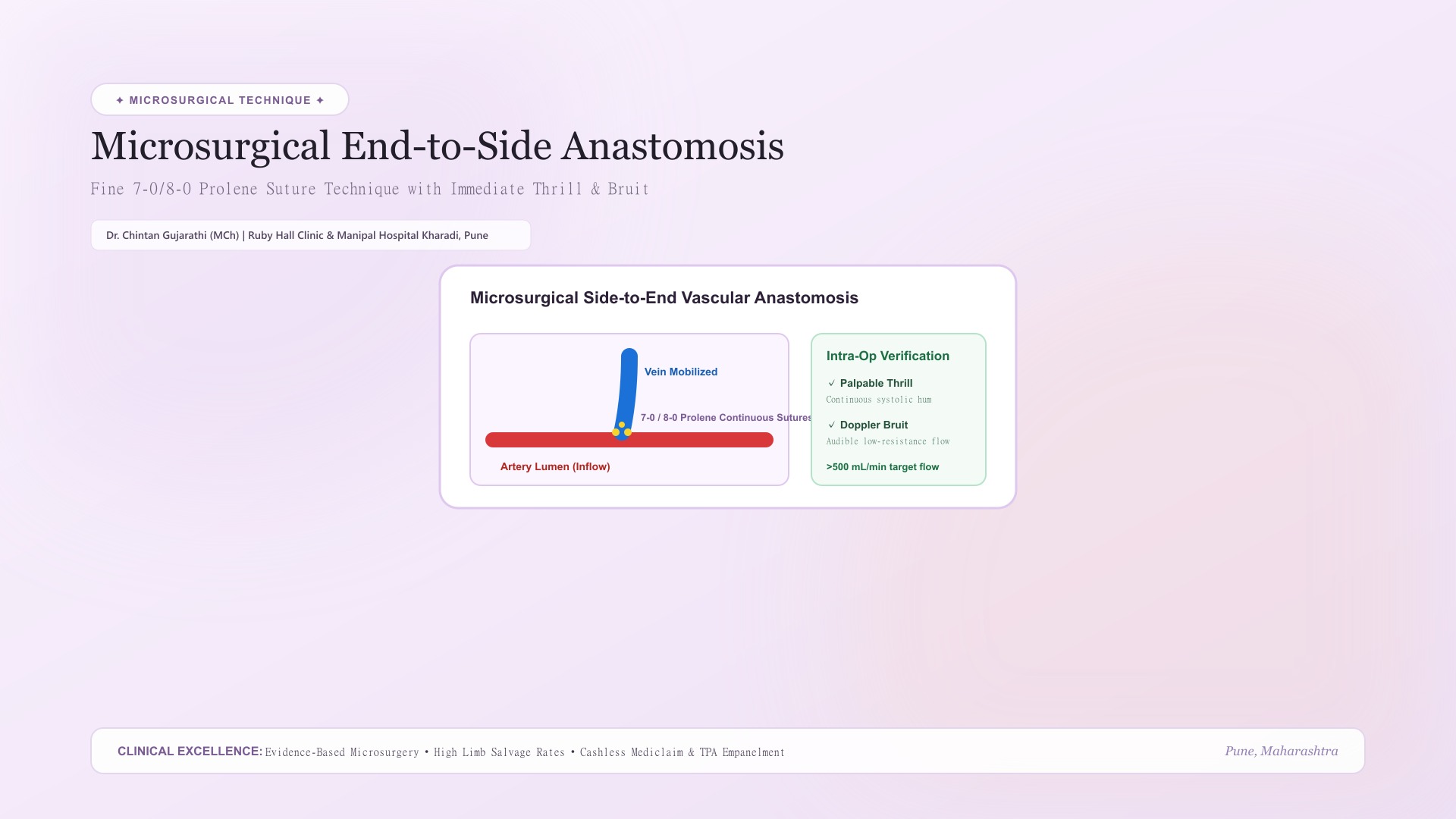
Surgical Approaches & Precision Techniques✦
Radiocephalic AV Fistula (Brescia-Cimino Wrist Fistula)
Primary distal forearm side-to-end anastomosis connecting the radial artery to the cephalic vein at the wrist, preserving proximal veins.
Your Healing Journey & Care Guide✦
A straightforward clinical guide to what to expect and how to care for your results.
Immediate Thrill Check & Arm Elevation
Patient is discharged home within 2 to 4 hours. A buzzing vibration (thrill) is felt in the arm. Incision discomfort is very mild.
Feeling that buzzing "thrill" under your fingertips confirms your fistula is patent and pumping healthy arterial blood.
First Review & Ball Squeezing Initiation
Skin stitches are checked and removed around day 10–12. Swelling completely subsides. The vein begins to enlarge.
Regular rubber-ball squeezing exercises increase blood flow through the forearm, stimulating the vein to thicken and dilate rapidly.
Progressive Maturation & Vessel Wall Thickening
The outflow vein becomes visibly prominent, smooth, and firm under the skin. Blood flow increases steadily.
Never allow anyone to measure blood pressure or draw blood from your fistula arm—this must be strictly enforced.
Maturation Ultrasound & First Cannulation
Doppler ultrasound confirms the "Rule of 6s" (>600 mL/min flow, >6 mm diameter, <6 mm depth). Fistula is cleared for dialysis.
Once your native fistula is working smoothly, your nephrologist can safely remove the temporary catheter, eliminating infection risk.
Recommended Best Practices (Do's)
- Check your fistula every morning and night by gently placing your fingers over the scar to feel for the continuous buzzing "thrill".
- Keep your arm elevated on two pillows while resting during the first week to eliminate surgical swelling.
- Perform your soft rubber-ball squeezing exercises strictly as instructed (10 minutes, 3 to 4 times a day) starting after week 1.
- Keep the surgical incision clean and completely dry until your first follow-up visit with Dr. Gujarathi.
- Inform your dialysis nurses to always rotate needle puncture sites along the length of the vein to prevent aneurysmal dilatation.
Precautions & Safeguards (Don'ts)
- NEVER allow anyone to measure blood pressure (BP cuff) on your fistula arm.
- NEVER allow intravenous injections, IV cannulas, or routine blood samples to be drawn from your fistula arm.
- Do not sleep resting on your fistula arm or wear tight shirts, elastic bands, or tight wristwatches.
- Do not lift heavy weights, buckets of water, or carry heavy shopping bags with your operated arm.
- If the buzzing thrill suddenly stops or feels weak, contact Dr. Gujarathi immediately—early clot removal within 24 hours saves the fistula.
Frequently Asked Questions✦
Essential clinical answers on surgical safety, scars, and recovery in Pune.
Schedule Your Consultation with Dr. Chintan Gujarathi
Available for personal clinical consultations and surgical assessment at premier accredited tertiary hospitals in Pune: