Cosmetic Facial Suturing✦ in Pune
(Emergency Micro-Layered Stitching for Cuts & Lacerations)
Emergency Microsurgical Layered Closure, Subdermal Tension-Free Suturing & Scar Minimization
An accidental facial cut—whether from a road mishap, sports collision, broken glass, or a child’s fall at home—requires immediate specialized plastic surgery attention. When sutured with coarse hospital casualty stitches, facial cuts frequently heal with wide, depressed scars and unsightly cross-hatch "railroad track" marks. Dr. Chintan Gujarathi utilizes emergency microsurgical techniques to reconstruct anatomical tissue layers with microscopic precision, ensuring the scar heals as a hairline, barely noticeable mark.
Operated by Dr. Chintan Gujarathi (MCh Plastic Surgery, Tata Memorial Hospital Fellow) at accredited tertiary centers (Ruby Hall Clinic, Sassoon Rd & Manipal Hospital Kharadi), utilizing sub-millimeter precision, concealed micro-incisions, and advanced tissue-handling for natural, permanent outcomes.
7-0 / 8-0 — Micro-Sutures
Thinner than hair
0 Scars — Railroad Marks
Subdermal knots
15-30m — Day-Care Repair
Local / painless
5 Days — Early Removal
Puncture prevention
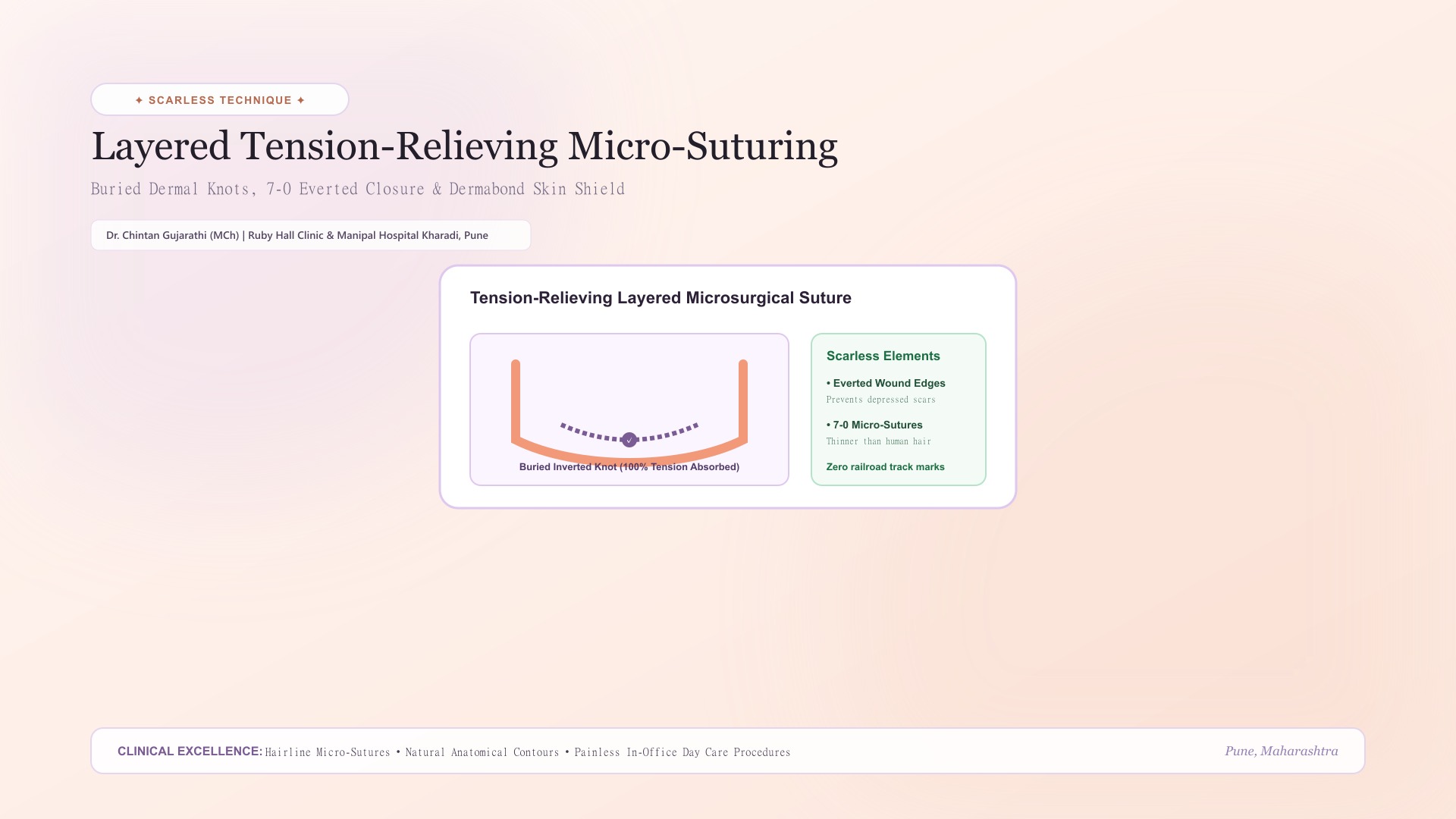
Surgical Approaches & Precision Techniques✦
Multi-Layer Tension-Relieving Subdermal Closure
Deep 5-0 absorbable dermal stitches that bear 100% of skin tension, allowing epidermis to meet tension-free with ultra-fine 6-0/7-0 monofilament.

Your Healing Journey & Care Guide✦
A straightforward clinical guide to what to expect and how to care for your results.
Clean Healing & Swelling Control
Minimal pain, easily controlled with mild oral analgesics. A thin layer of antibiotic ointment or Dermabond film protects the cut.
Gentle cleaning with sterile saline and applying prescribed antibiotic ointment twice daily keeps the healing edges supple.
Early Suture Removal (No Needle Marks)
Fine surface stitches are painlessly removed at the clinic on Day 5, preventing any permanent needle puncture marks.
Removing facial stitches early on Day 5 is the secret to avoiding railroad-track scar lines.
Scar Maturation & Silicone Gel Therapy
The healing incision line looks pink and thin. Medical silicone gel application begins to flatten collagen fibers.
Sun protection with SPF 50+ prevents hyperpigmentation and dark staining of the fresh scar line.
Hairline Invisibility & Complete Fading
The pink color fades to match surrounding skin tone. The scar becomes virtually imperceptible under normal lighting.
Facial collagen continues to remodel for up to 12 months, becoming softer, flatter, and even less noticeable over time.
Recommended Best Practices (Do's)
- Keep the sutured wound clean and dry for the first 24 to 48 hours as directed by Dr. Gujarathi.
- Apply the prescribed antibiotic ointment or silicone scar gel gently along the suture line twice daily.
- Attend your scheduled follow-up on Day 5 to 7 for prompt, painless removal of fine surface sutures.
- Protect the healing pink scar from direct sunlight by using broad-spectrum SPF 50+ sunscreen for at least 6 months.
- Contact Dr. Gujarathi immediately if you notice unexpected redness, increasing pain, or fever.
Precautions & Safeguards (Don'ts)
- Do not pick, scratch, or peel dry scabs along the healing cutline.
- Do not apply harsh rubbing alcohol, spirit, or burning hydrogen peroxide to the wound.
- Do not allow dirty tap water or swimming pool water to soak the fresh suture line during the first week.
- Do not participate in rough contact sports that could accidentally reopen the healing facial cut.
- Do not apply heavy cosmetic foundation or concealer directly over unhealed stitches.
Frequently Asked Questions✦
Essential clinical answers on surgical safety, scars, and recovery in Pune.
Schedule Your Consultation with Dr. Chintan Gujarathi
Available for personal clinical consultations and surgical assessment at premier accredited tertiary hospitals in Pune: