Microvascular Surgery✦ in Pune
(Supermicrosurgery, Free Perforator Flaps, Free Fibula Jaw Reconstruction & LVA)
Super-Microsurgical Free Tissue Transfer, Perforator Flaps & Lymphaticovenular Anastomosis (LVA)
Microvascular surgery represents the absolute pinnacle of reconstructive plastic surgery. When extensive tissue loss occurs due to high-energy trauma, severe industrial accidents, or radical oncological resections (such as oral cancer, sarcoma, or breast cancer), conventional skin grafts or local flaps cannot provide adequate coverage. Microvascular free tissue transfer involves disconnecting living vascularized tissue (skin, fat, muscle, or living bone) from a distant donor site, transferring it to the defect, and reconnecting its 1 to 2 mm feeding artery and draining veins under high-power surgical microscopes using stitches finer than human hair. Dr. Chintan Gujarathi, fellowship-trained in Head & Neck and Reconstructive Microsurgery at the prestigious Tata Memorial Hospital, delivers world-class microvascular success rates exceeding 98% across Pune.
Operated by Dr. Chintan Gujarathi (MCh Plastic Surgery, Tata Memorial Hospital Fellow) at accredited tertiary centers (Ruby Hall Clinic, Sassoon Rd & Manipal Hospital Kharadi), utilizing sub-millimeter precision, concealed micro-incisions, and advanced tissue-handling for natural, permanent outcomes.
20x Micro — Optical Power
Sub-millimeter micro-vessels
500+ — Free Flap Cases
Tata Memorial Hospital training
98% — Flap Success Rate
Continuous Doppler monitoring
0.3 mm — Super-Microsurgery
LVA lymphedema bypass
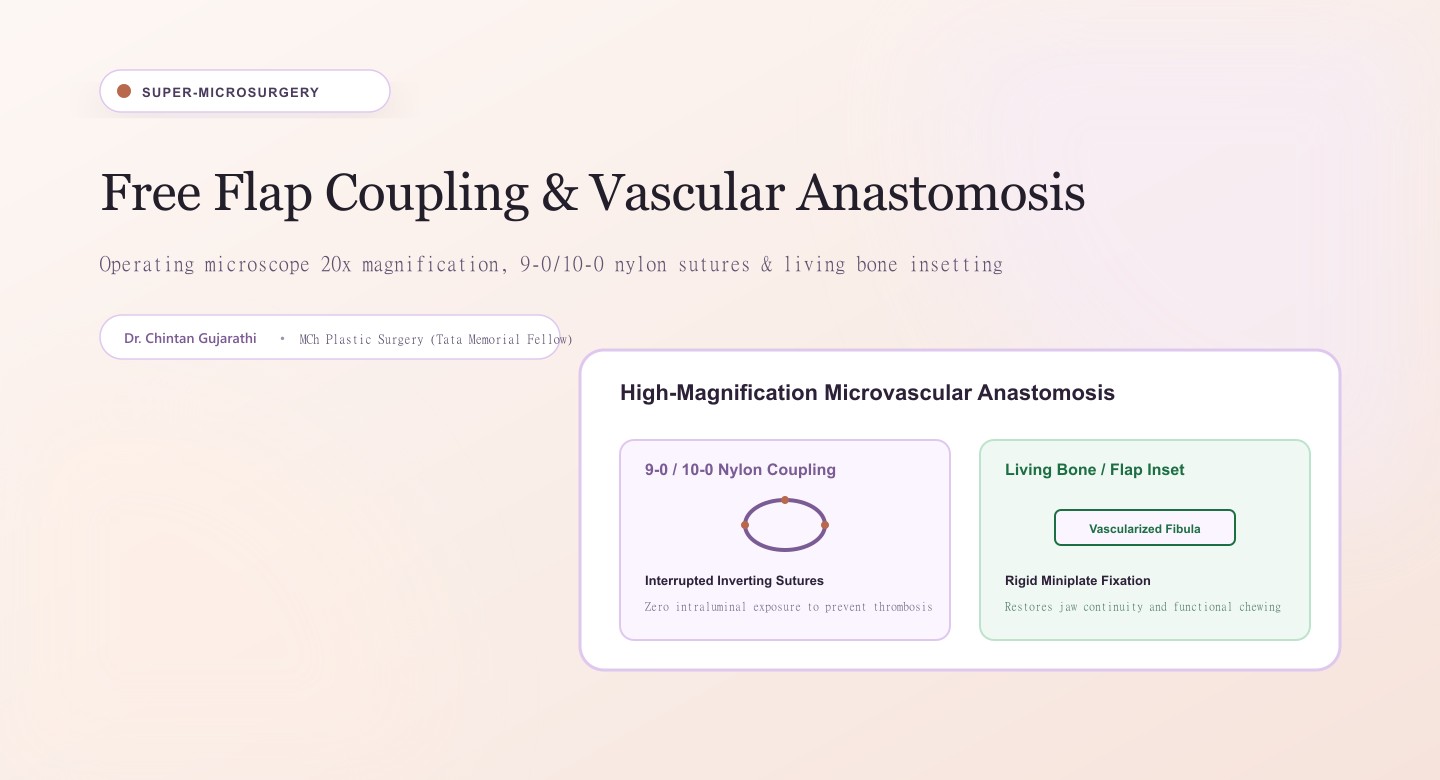
Surgical Approaches & Precision Techniques✦
Free Perforator Flaps (ALT & DIEP)
Anterolateral thigh (ALT) and deep inferior epigastric perforator (DIEP) microvascular transfer with sub-millimeter vessel coupling.
Your Healing Journey & Care Guide✦
A straightforward clinical guide to what to expect and how to care for your results.
Microsurgical ICU Monitoring
Intensive post-operative care in a warm room. Dedicated nurses perform hourly flap temperature and Doppler flow checks.
Warm ambient room temperature prevents peripheral vessel constriction, keeping the microvascular connection open.
Step-Down to Private Ward
Flap is biologically secure and thriving. The vascular connection has passed the critical 72-hour thrombosis window.
Once past Day 5, the flap begins forming early capillary bridges with surrounding tissues.
Discharge Home & Functional Rehabilitation
Discharge home. Flap has 100% incorporated into the defect. Donor site incisions are healed.
Continue drinking adequate fluids and avoid smoking or passive tobacco smoke completely.
Long-Term Structural & Functional Restoration
Full tissue maturation. Living bone has completely united with recipient bone. Defect is permanently healed.
Because living vascularized tissue was transferred, the flap will never shrink or breakdown, lasting for the rest of your life.
Recommended Best Practices (Do's)
- Keep the room warm and comfortable to prevent vessel vasospasm.
- Follow prescribed hydration and oral fluid intake goals faithfully.
- Participate actively in speech, swallowing, or physical rehabilitation sessions.
- Follow up regularly for flap checks and dental implant integration planning.
Precautions & Safeguards (Don'ts)
- Do not smoke, vape, or use any tobacco/nicotine products (nicotine causes instant microvascular thrombosis).
- Do not apply direct ice or cold packs anywhere near the reconstructed flap.
- Do not wear tight clothing, restrictive collars, or jewelry that could press on the vascular pedicle.
- Do not skip scheduled blood thinner medications during the first 2 weeks.
Frequently Asked Questions✦
Essential clinical answers on surgical safety, scars, and recovery in Pune.
Schedule Your Consultation with Dr. Chintan Gujarathi
Available for personal clinical consultations and surgical assessment at premier accredited tertiary hospitals in Pune: